Fire-hardened. Documented. Insurable.
Most of our service area sits inside California's Very High Fire Hazard Severity Zones. We install documented Class A assemblies — and hand you the paperwork your insurer and building department ask for.
Class A is an assembly, not a shingle
A Class A rating belongs to the whole tested system — substrate, underlayment, and surface together. That distinction is exactly what building departments check and insurers underwrite — especially in the fire-zone hillsides of Agoura Hills, Malibu, Calabasas, Oak Park, and Woodland Hills.
Chapter 7A of the California Building Code requires Class A roof assemblies in designated fire hazard zones — which covers most of the hills from Malibu and Topanga through the Conejo grade. We install documented Class A systems: tile and concrete-shake assemblies, standing seam metal, and ember-resistant detailing at eaves, vents, and valleys where structures actually ignite. You receive the assembly documentation with your closeout file.
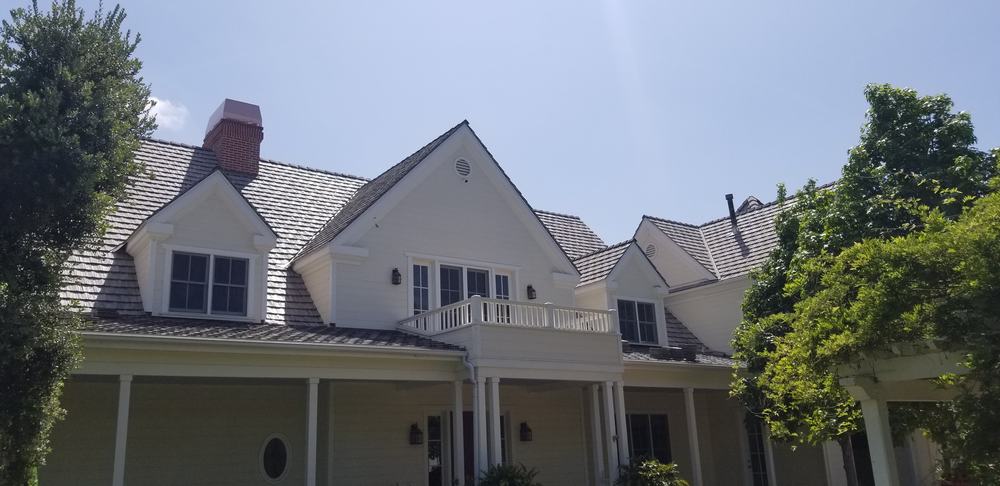
Since the January 2025 fires, that documentation is often the difference between a standard homeowner's policy and the FAIR Plan. If your home still wears wood shake, our shake-to-Class-A conversions — like the CedarLite concrete shake system — keep the look and retire the risk.
Financing options for qualifying projects
Skim the facts — then just ask at your assessment.
- Instant pre-approval decisions
- Soft credit check — zero impact to your score
- Plans matched to your goals and budget
- Spread costs over time, preserve your cash
- Always optional — never a condition of hiring us
- You review the full terms before accepting anything
The Top-Down Assessment
What happens when you book with Top Armor — protecting properties from the top down.
Your assessment is led by a hands-on roofing contractor — not a commissioned salesperson. Some companies inspect your roof from the driveway; we put three decades of experience on the roof itself — and when aerial imaging helps, you’ll watch the drone’s view live from the ground.
Talk to the expert, not a script
An experienced roofing contractor — often the owner — leads your assessment in person, with straight answers and real-time insights on the spot.
A documented, hands-on inspection
We inspect the roof itself and document everything in photos and video. When a drone view is useful — or you'd just like to see your roof up close — you'll watch the live aerial feed from the ground.
Measured to the inch
Inspection findings plus a precision aerial dimensional report become options that actually fit — matched to your goals and budget, not a sales quota.
A real proposal in 1–2 days
A written condition assessment and detailed proposal: options, exact materials and why, recommended upgrades — priced and explained.
Start your roof assessment Free assessment · Led by an expert, not a salesperson · Proposal in 1–2 days · Warranties: up to 50-yr system, up to 10-yr workmanship
Questions we hear
Does my home need a Class A roof?
If it sits in a Very High Fire Hazard Severity Zone — most hillside neighborhoods from Malibu through the Conejo — Chapter 7A requires a Class A assembly on replacement. Your assessment includes a zone check and the documentation plan.
Will a fire-hardened roof help my insurance?
Documentation helps: insurers increasingly ask for proof of Class A assemblies and ember-resistant features. We can't promise any carrier's decision, but we provide the assembly documentation underwriters ask to see.
Can I keep the wood-shake look?
Yes — Class A concrete shake systems like CedarLite replicate the profile with a non-combustible material. See the Somis conversion in our projects.
In roofing, histories get bought. Licenses don't. CSLB #661698 is the longest-standing active roofing license in the Conejo Valley — issued in 1993 and held by the same contractor, our founder, every day since. Our story →
Ready when you are
Three quick questions, a real expert on your roof, and a written proposal in 1–2 days. A human calls back within 24 hours.